How Does a Cantilever Sliding Gate Deliver Smooth Access Without Ground Rails?
 FACEBOOK
 TWITTER
 LINKEDIN
Cantilever sliding gates are a suitable alternative for sites requiring secure vehicle access where a traditional rail gate would not be practical due to ground conditions. Everyday use of a gate in mud, dust, snow and ice, on gravel, over drainage slopes or on uneven concrete can soon wear down a gate’s movement, especially when used for months at a time. From factories and logistics parks, through to government compounds, schools, shops and commercial properties as well as residential estates, the issue is not so much whether a gate can be opened and shut, but whether it will continue to function properly over time.
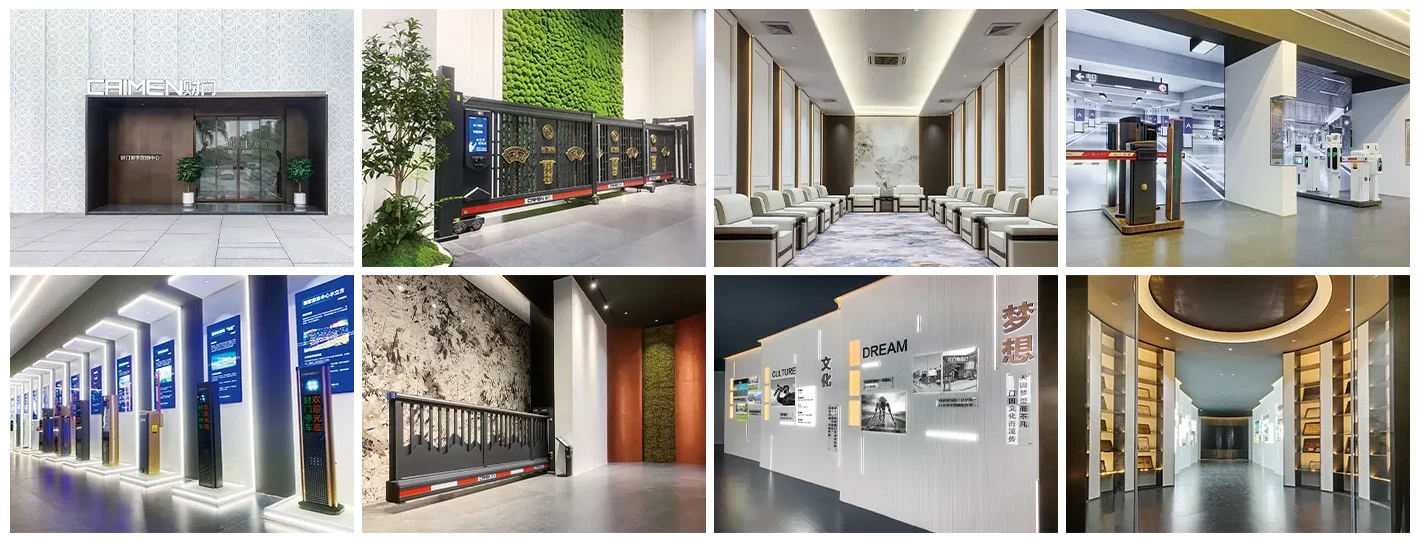
CAIMEN is a manufacturer of smart auto gates and parking access solutions, with in-house R&D, production, customization, and project support for entrance control systems. Its engineering focus makes it worth considering when buyers need a gate system matched to real site conditions rather than a standard catalog model.
Problem / Selection Logic
Why Ground Rails Become a Maintenance Issue
Traditional sliding gates usually rely on a ground track. This can work well on clean, flat, and well-drained surfaces, but many project sites are not that stable. Heavy trucks may damage the track. Dust and small stones may build up in the rail. Snow and ice may block the rolling path. Rainwater and mud may increase friction or corrosion risk.
For a buyer, these issues create hidden costs. The purchase price of the gate may look acceptable, but regular cleaning, misalignment, wheel wear, motor overload, and emergency repair can affect the real operating cost.
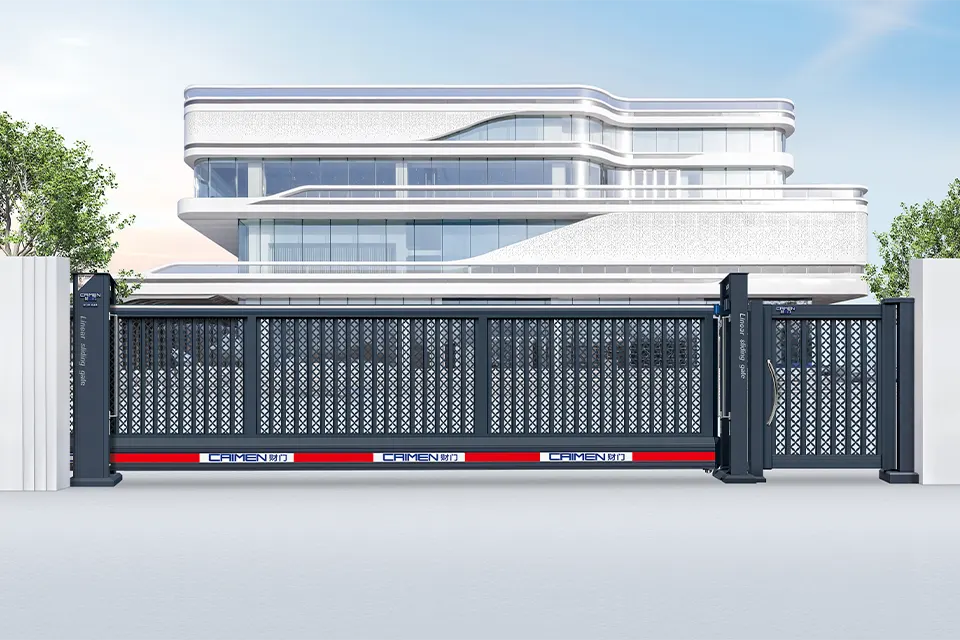
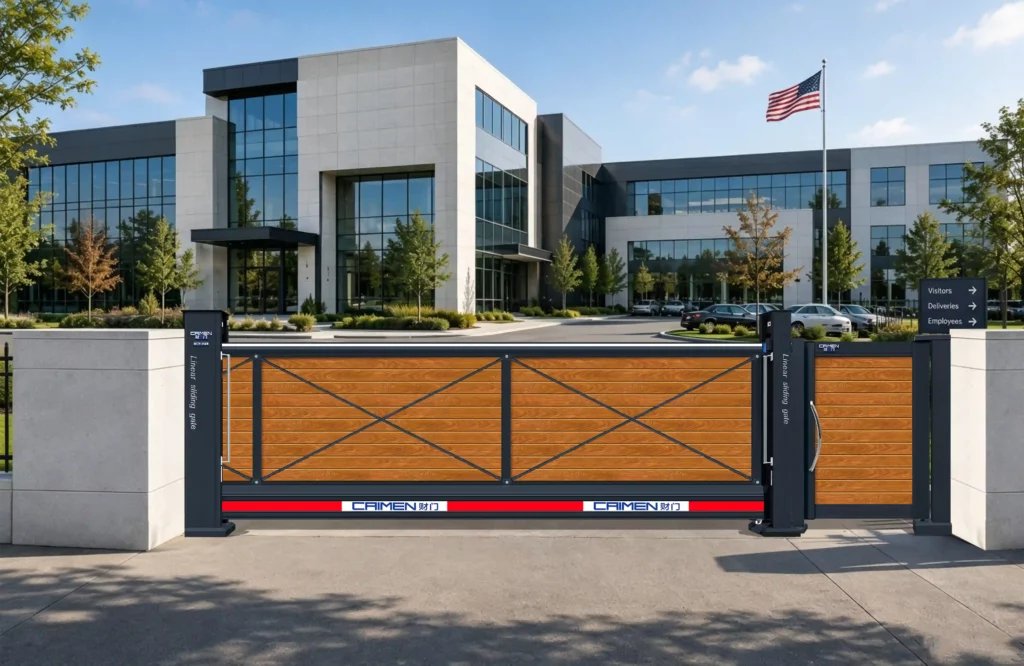
A cantilever sliding gate removes the ground rail from the driveway. The gate moves parallel to the fence line while the load is carried by the cantilever structure and support assembly. That is why it is often selected for outdoor entrances where surface conditions are hard to control.
Which Option Is Better for Industrial Entrances
For a small private driveway with smooth paving and light usage, a simple tracked sliding gate may be enough. For a busy industrial entrance, the selection logic is different. Buyers usually care about:
- Can the gate operate during rain, dust, or snow?
- Will forklifts, trucks, or construction vehicles damage the track?
- Is the entrance wide enough for large vehicles?
- Can the gate integrate with license plate recognition, remote control, or access systems?
- How much maintenance will the facility team need to handle?
When these questions matter, a trackless cantilever sliding gate is usually the stronger option. It keeps the traffic lane clear and reduces the risk of track blockage.
How Does a Cantilever Sliding Gate Work Without Ground Rails?
A Suspended Structure Carries the Gate Load
No rail required for the gate leaf – the cantilever frame with rollers, wheels and other supports allow it to be elevated off the driveway surface to move over uneven surfaces without contact.
For long-span gates, the strength of the beam system is critical. CAIMEN’s cantilever sliding gate uses aluminum alloy profiles such as 6005-T6 and 6063-T6, with reinforced beam sections designed to improve rigidity and reduce sagging during long-term movement. For larger entrances, the bottom beam, pull rod, vertical bars, and gantry structure all need to work together as one load-bearing system.
This is where buyers should avoid judging only by appearance. A slim gate may look clean, but for a long opening width, the real value is in beam thickness, structural cavity design, fastening method, and anti-sagging support.
Guided Motion Keeps the Gate Straight
Smooth access depends on controlled movement. A cantilever sliding gate normally uses guide wheels, correction wheels, limit sensing, and rear support components to keep the gate moving in a straight path. The purpose is to reduce shaking, friction, and side pressure.
The Cantilever Sliding Gate from CAIMEN includes components such as correction wheels, tail levers, inner guide wheels, and limit sensing systems. These parts are not decorative. They help the gate body stay aligned, reduce noise, protect the motor from excessive operation, and improve daily stability.
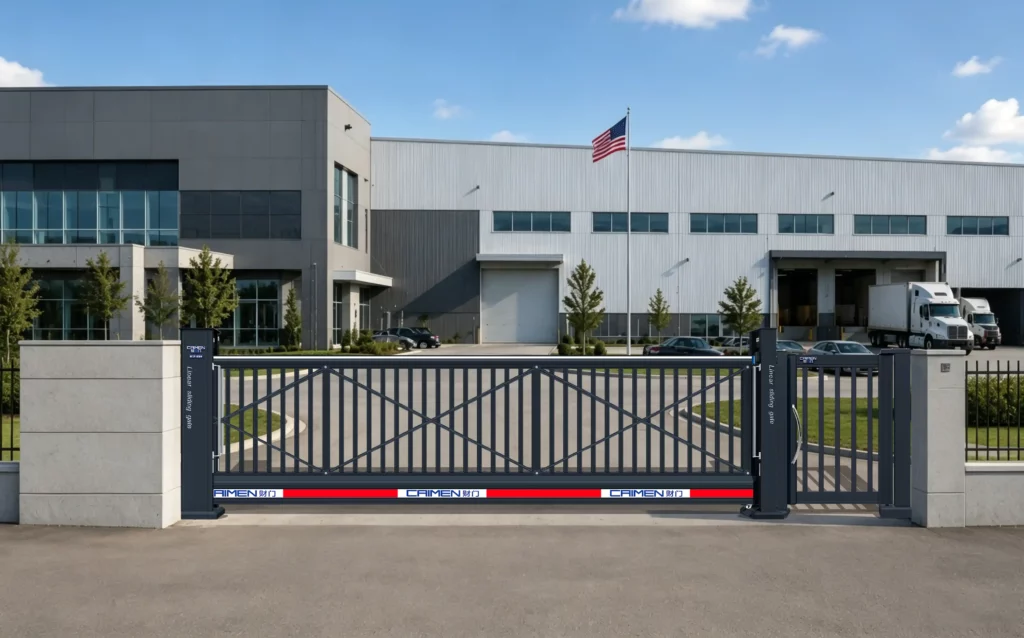
For procurement teams, this means the gate should be evaluated as a complete operating system. The motor, guide system, beam structure, control cabinet, sensors, and foundation layout all affect the final result.
Smart Control Smooths Start and Stop
A gate that starts too aggressively or stops too sharply can create vibration, noise, and wear. For high-frequency sites, smooth acceleration and deceleration are important. The control system adjusts movement speed, monitors position, and coordinates safety response.
Modern cantilever sliding gates can be connected with remote controls, mobile app control, Bluetooth identification, license plate recognition, RFID, face recognition, fingerprint access, ground sensing, and other intelligent modules. This makes the gate suitable for different access policies, from simple remote opening to integrated vehicle management.
For factories or commercial parks, a useful setup may combine a cantilever gate with a boom barrier and license plate recognition. During peak traffic hours, the barrier handles fast vehicle passage. At night or during high-security periods, the cantilever gate provides a stronger physical barrier.
When Should You Choose a Cantilever Sliding Gate?
Choose It for Uneven, Wet, or Dirty Ground
A cantilever sliding gate is a practical choice when the entrance has water, mud, sand, gravel, ice, or snow. Since there is no rail across the driveway, the gate is less affected by debris accumulation.
This does not mean the system can ignore installation accuracy. The foundation, motor cabinet, gantry frame, and hanging wheels still need to be installed on a properly leveled base. For CAIMEN’s installation guidance, the key support areas require a controlled level surface, and the concrete foundation should be prepared according to project requirements.
The decision is not “no foundation needed.” The better logic is “no ground rail across the traffic lane, but the support structure still needs a reliable base.”
Choose It When Space and Traffic Flow Matter
A cantilever sliding gate moves horizontally along the fence line or boundary. It does not need the front or rear swing clearance required by a swing gate. This makes it suitable for entrances near roads, parking lanes, factory yards, guardhouses, and narrow access points.
For B2B sites, this can improve both safety and land use. Vehicles do not need to wait for a large swing arc, and the entrance can remain more predictable during busy hours.
Buyers comparing options should check the available side space for the gate leaf and counterbalance section. A cantilever gate needs enough lateral space to slide fully open. If the side space is limited, other options from a broader product range may need to be compared.
Choose It for Security and Access Control
A cantilever sliding gate is often selected for sites that need more than a simple opening device. It can act as a physical perimeter barrier while connecting with access control systems.
Useful safety and security features may include:
- Infrared anti-collision sensing
- Pressure wave safety edge
- Mechanical anti-pinch protection
- Emergency stop device
- Anti-climb alarm
- Manual clutch for power failure
- Automatic locking or self-locking function
- Remote or app-based control
For public institutions, industrial parks, warehouses, campuses, and controlled residential areas, these features help balance smooth vehicle entry with perimeter security.
What Should Buyers Check Before Buying a Cantilever Sliding Gate?
Opening Width, Gate Height, and Structural Strength
The first technical check is size. Entrance width, required clear opening, vehicle type, and site layout determine the gate length. CAIMEN’s product information indicates that custom cantilever gate solutions can support large spans, with project-dependent customization for length, height, gate row style, color, and decorative parts.
For wide openings, ask about bottom beam size, wall thickness, pull rod design, and wind resistance reinforcement. In coastal or high-wind areas, buyers should request a specific engineering recommendation rather than using a standard model directly.
Material and Surface Treatment
When selecting gates to go outside, resistance to corrosion, to UV, and to aging of surface is required. Aluminum alloys are generally preferred because they are lighter than steel and are naturally rust resistant. However, the alloy used, the profile thickness and the coating process are critical.
A fluorocarbon powder coating or weather-resistant powder coating can help improve color retention and outdoor durability. For export projects, buyers should also ask whether the supplier can provide CE-related documentation, coating information, installation drawings, and project-specific technical support.
Safety Devices and Control Compatibility
Before placing an order, confirm which safety features are standard and which are optional. For example, infrared sensors, pressure wave safety edges, anti-pinch devices, anti-climb alarms, warning lights, voice prompts, and LED displays may vary by configuration.
Control compatibility is equally important. A gate may need to work with an existing security room, parking system, license plate recognition camera, intercom, access card reader, or mobile app. If the project has multiple entrances, ask whether the supplier can support unified control logic and consistent user permissions.
Foundation and Installation Conditions
A trackless gate reduces the need for a driveway rail, but it still requires accurate installation. Buyers should confirm foundation dimensions, concrete strength, embedded parts, cable routing, grounding, power supply, drainage, and leveling tolerance before shipment.
For overseas projects, clear installation manuals, CAD drawings, wiring diagrams, and video support can reduce mistakes. If local installers are not familiar with cantilever systems, the supplier should explain the key adjustment points, including guide wheel alignment, limit position setting, motor direction, safety sensor testing, and manual release operation.
How Does CAIMEN’s Cantilever Sliding Gate Fit Real Project Needs?
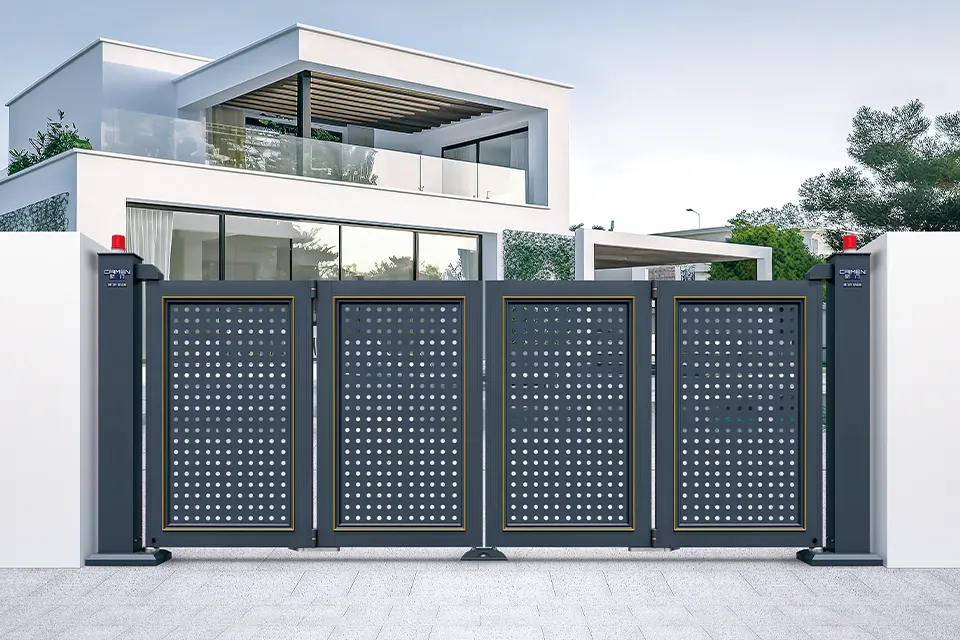
Our CAIMEN cantilever sliding gate is suitable for very heavy industrial sites, logistics centers, shops and companies that require a high security perimeter. The trackless suspended system of this gate type eliminates the major problems of conventional sliding gates along a rail, such as jamming, blocking by debris, and the regular cleaning of the rails.
The product also supports customization in gate height, length, gate leaf style, color, and decorative design. For projects that require a complete entrance system, CAIMEN can combine electric gates with smart parking, license plate recognition, boom barriers, face recognition access control, and IoT-based management.
Its project references can help buyers review different application scenarios, while the About Us page gives more context on manufacturing, R&D, and one-stop service capability.
For the buyer it is not one special feature which has advantages. The advantages for the buyer are structure, control, safety and flexibility. The advantages matter most when the gate is used daily and is part of a real entrance and not just a nice showpiece in a catalog.
FAQ
Q1: Is a cantilever sliding gate better than a tracked sliding gate?
A cantilever sliding gate is usually better for uneven, dirty, wet, snowy, or high-traffic entrances because it does not rely on a ground rail. A tracked sliding gate can still work for clean, flat, and low-maintenance sites. The better option depends on ground condition, traffic frequency, required security level, and available side space.
Q2: Does a cantilever sliding gate need a foundation?
Yes. It does not need a ground rail across the driveway, but the motor cabinet, support structure, gantry, and guide system still need a stable foundation. Proper leveling, concrete strength, drainage, and embedded parts are important for smooth operation.
Q3: Can a cantilever sliding gate work with license plate recognition?
Yes. A cantilever sliding gate can be integrated with license plate recognition, remote control, mobile app control, RFID, Bluetooth, face recognition, fingerprint recognition, and other access systems. For busy entrances, many projects use a boom barrier for peak-hour traffic and a cantilever gate for stronger perimeter closure.