What Automatic Gate Features Matter Most for Modern Factory Security?
 فيسبوك
 تويتر
تويتر
 لينكدين
Factory entrances are no longer simple openings in a fence line. Access to your factory is controlled by trucks, employees, visitors, contractors and for emergencies such as a fire, gate access. You may also have goods of high value moving into and out of your factory. The automatic gate features can add value to your security at the factory gate but there are some very important considerations in choosing the correct features to maximize security without impediment to the smooth flow of traffic, minimizing maintenance, and ensuring safety.
For buyers, the question is not only “Which gate looks strong?” but “Which gate system can keep working under daily industrial use?” A modern factory gate should combine mechanical strength, access control, safety protection, smart operation, and site-specific customization.
ملخص تنفيذي
The most important automatic gate features for modern factory security are structural strength, stable opening performance, smart access control, anti-collision protection, weather resistance, emergency operation, and customization for the actual entrance layout.
For factories, a gate is not a decorative product. It is part of a security workflow. A good system should help security teams control vehicle access, reduce manual checking errors, support high-frequency movement, and remain reliable in outdoor conditions.
When choosing an automatic gate it is important to consider the following factors: the size of the entrance, the available space on the sides, the volume of traffic, the size of vehicles that use the entrance, the power requirements, the method of control, safety features such as sensors, the finish of the coating and the level of service and support that the supplier offers. A telescopic sliding gate can be more suitable for wide industrial gates with limited space for storage than a traditional single-panel sliding automatic gate, as it has the advantage of reduced sliding distance as it is made up of individual panels.
Problem and Selection Logic for Factory Gate Buyers
Factory buyers often compare price first, but the lowest gate cost can create higher long-term maintenance costs. A poorly matched gate may open too slowly, shake under frequent use, fail in rain or dust, or require guards to override the system too often.
The better selection logic starts with the entrance conditions. A factory with container trucks has different needs from a warehouse park, food plant, industrial estate, or logistics depot. The buyer should first ask:
Which option is better for the available space?
When should the gate open fully, partially, or in sections?
What should be checked before buying to avoid installation problems?
How does the system improve security performance during daily operation?
A factory security gate should match the site, not force the site to adapt to the gate.
Which Automatic Gate Features Matter Most for Modern Factory Security?
Structural Strength for Industrial Traffic
The first feature to check is the gate structure. Factory gates may operate many times per day, often around heavy vehicles, forklifts, and delivery trucks. Thin frames, weak joints, or unstable support systems can lead to sagging, shaking, or alignment problems.
For industrial use, buyers should check the frame material, beam thickness, welding or assembly quality, and support method. Aluminum alloy structures are often preferred when corrosion resistance and lighter operation matter. Steel may be used where impact resistance or heavy-duty frame rigidity is the priority.
A stronger structure also protects the motor system. When the gate body stays aligned, the drive unit works with less strain, which helps improve service life and reduces maintenance calls.
Space-Saving Opening Design
Space is often the hidden problem at factory entrances. A swing gate may block internal roads or pedestrian areas. A long sliding gate may require a large side pocket. A folding gate saves space but may not suit every traffic pattern.
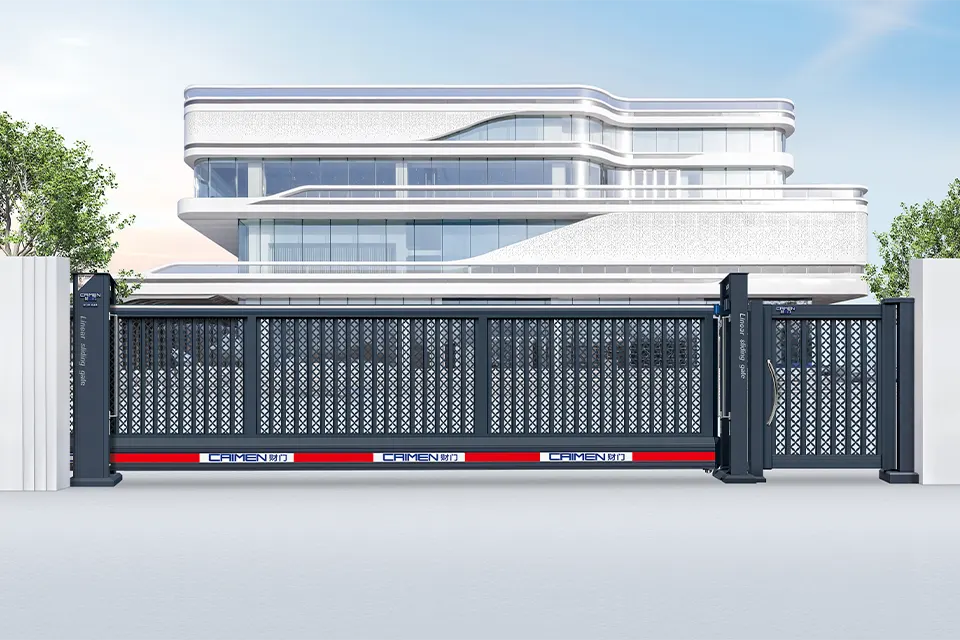
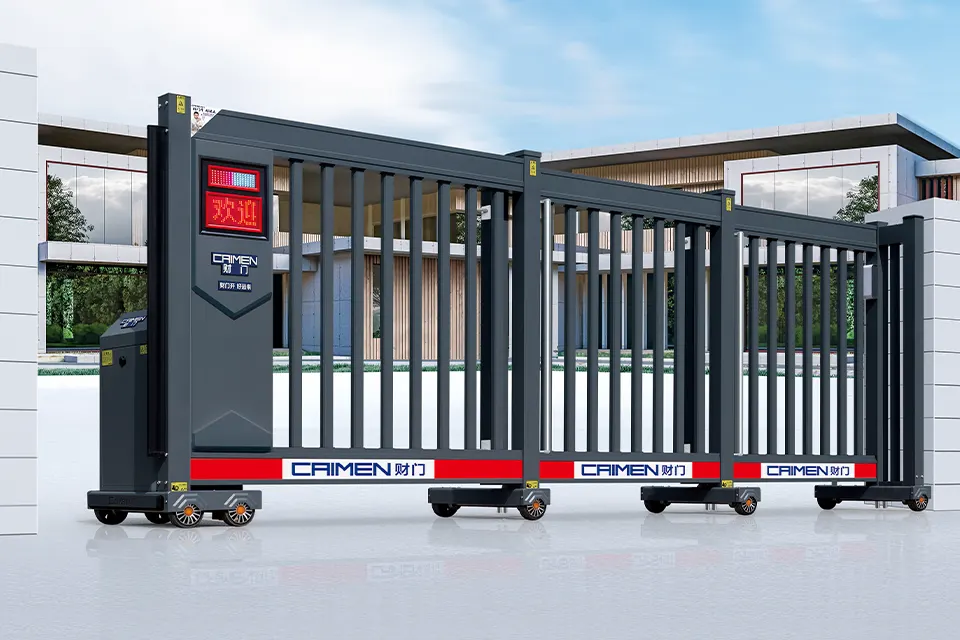
This is where telescopic sliding design becomes useful. A telescopic sliding gate divides the gate body into multiple sections, allowing the system to open with a shorter rear storage distance than a conventional single sliding gate. CAIMEN’s البوابات المنزلقة التلسكوبية are designed with modular sections, customizable height and length, and a sliding mechanism suited to entrances where space efficiency matters.
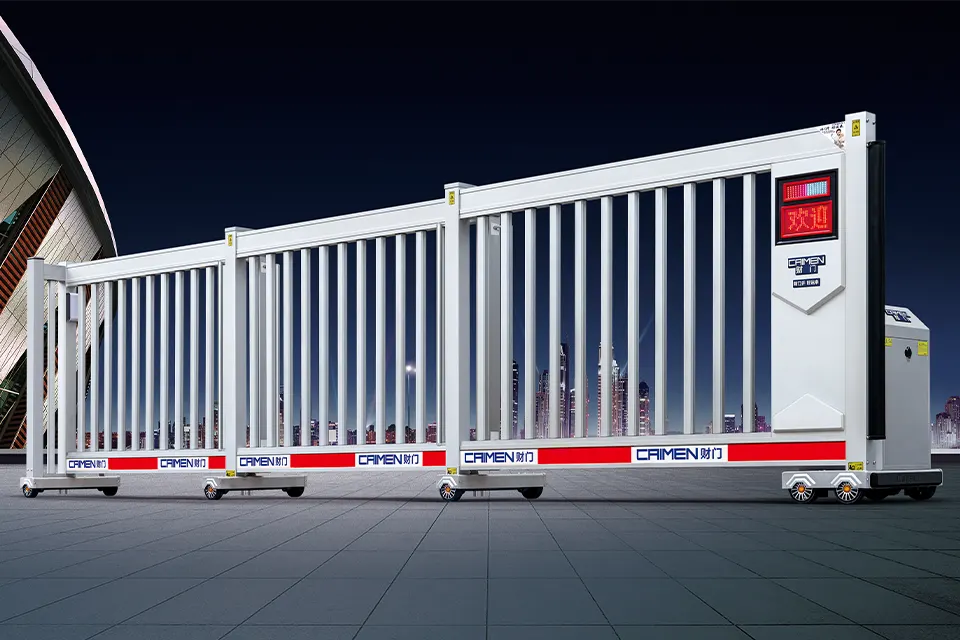
Choose a telescopic sliding gate when the entrance is wide but the side clearance is limited. Choose a standard sliding gate when there is enough straight side space and the buyer wants a simpler opening structure. Choose a folding gate when the entrance has very tight lateral space and fast inward folding is preferred.
Smart Access Control Compatibility
Modern factory security depends on controlled entry, not only physical blocking. A gate should support access control systems such as remote control, license plate recognition, mobile app control, card access, face recognition, or integration with a security management platform.
For a logistics facility, license plate recognition can speed up registered truck entry. For a manufacturing plant, card or employee identity access may be more useful. For a business park, a combined solution with visitor registration and vehicle records may improve management.
Before buying, check whether the gate control system can connect with the factory’s existing security software, guardhouse process, and parking control equipment. A gate that cannot communicate with the access system may require extra manual work, which weakens the whole security setup.
Safety Sensors and Anti-Collision Protection
A secure gate must also be safe. Factory entrances involve moving vehicles, pedestrians, cyclists, and sometimes blind spots near the guardhouse. Safety protection should not be treated as an optional accessory.
Important safety features include infrared sensors, pressure-sensitive safety edges, anti-smash detection, warning lights, and emergency stop functions. These devices help detect obstacles during closing and reduce the risk of vehicle damage or personal injury.
For high-traffic entrances, buyers should ask how the gate reacts when an obstacle is detected. Does it stop? Does it reverse? How quickly does it respond? Is the sensor coverage suitable for the full opening width? These questions matter because a safety system only works well when it matches the gate size and traffic behavior.
Weather Resistance and Surface Treatment
Factory gates work outdoors for years. Sun exposure, rain, dust, snow, humidity, and industrial pollution can affect appearance and performance. A gate with poor coating may fade, peel, rust, or become harder to maintain.
Buyers should check the coating process, corrosion resistance, UV resistance, and operating temperature range. Powder coating, fluorocarbon treatment, and weather-resistant surface processes can help extend product life, especially in coastal, high-humidity, or high-sunlight regions.
For export buyers, surface durability also affects after-sales cost. Repainting or replacing gate panels after a short time can be expensive, especially when the project is located overseas.
Stable Drive System and Smooth Movement
The motor and transmission system determine whether the gate opens smoothly under daily use. A factory entrance gate should avoid sudden starts, hard stops, heavy vibration, and loud operation.
Soft start and soft stop functions help reduce mechanical shock. A reliable drive system also improves safety because the gate movement is more predictable. For sites with frequent truck movement, stable speed control can reduce waiting time without sacrificing safety.
Before buying, ask about motor power, operating cycle expectations, manual release during power failure, limit control, and spare parts availability. A gate that opens well in a showroom may not perform the same under industrial traffic unless the drive system is properly matched.
When Is a Telescopic Sliding Gate Better for Factory Security?
When the Entrance Is Wide but Side Space Is Limited
A telescopic sliding gate is often a strong choice when the factory entrance needs a wide opening but does not have enough side clearance for a full-length sliding panel. Because the gate sections move in a coordinated way, the storage space can be reduced compared with a traditional sliding gate.
This is useful for factories located near internal roads, walls, guardhouses, parking lanes, or loading zones. The buyer can maintain a wide vehicle entrance without wasting too much usable site area.
When Traffic Flow Needs Faster Clearance
A segmented gate can help improve opening efficiency because multiple sections move together. This can be useful where trucks enter during shift changes, delivery windows, or scheduled loading periods.
The buyer should still check the actual opening speed, safety setting, and control logic. Faster movement should never come at the cost of safety. The right system balances access speed with stable detection and controlled closing.
When the Factory Wants a Cleaner Entrance Layout
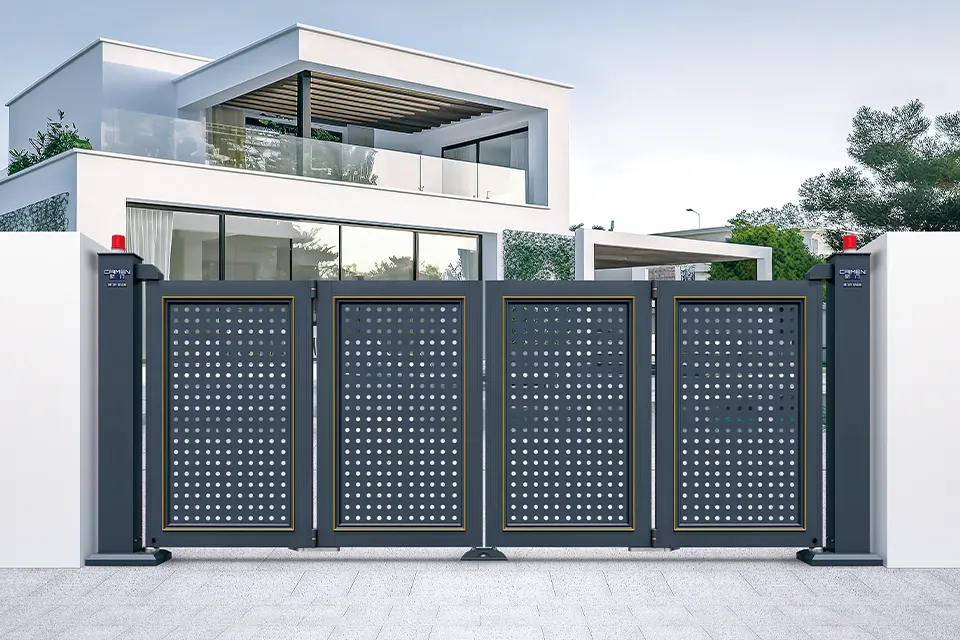
Factory entrances often represent the first impression of the site. A customized gate can match the fence line, building style, corporate color, and security room layout. Telescopic sliding gates can be customized in size, section count, color, and decorative style, which helps industrial buyers combine function with a cleaner visual result.
For buyers comparing gate types, the products page can help review different automatic gate categories before deciding which structure fits the entrance.
What Should Buyers Check Before Buying an Automatic Gate?
Site Dimensions and Civil Foundation
Before confirming a gate order, measure the clear opening width, total available side space, ground slope, road surface condition, and foundation position. Also check whether underground cables, drainage, curbs, or road markings will affect installation.
For factories with uneven ground, dust, mud, ice, or water accumulation, the buyer should pay extra attention to whether the gate requires a ground track. Trackless or suspended systems may reduce jamming risk in harsh outdoor environments.
Control Requirements and Security Workflow
The gate should support the factory’s real security process. A site with a guard booth may need remote control and manual verification. A high-volume logistics entrance may need license plate recognition. A restricted manufacturing area may need multi-level permission management.
Buyers should define the access process before choosing the gate. This avoids buying a strong mechanical gate that later needs costly control system modification.
Supplier Engineering Support
Industrial gate projects often require drawings, installation guidance, customization, and after-sales support. Buyers should check whether the supplier can provide CAD drawings, design confirmation, production planning, technical documentation, and project experience.
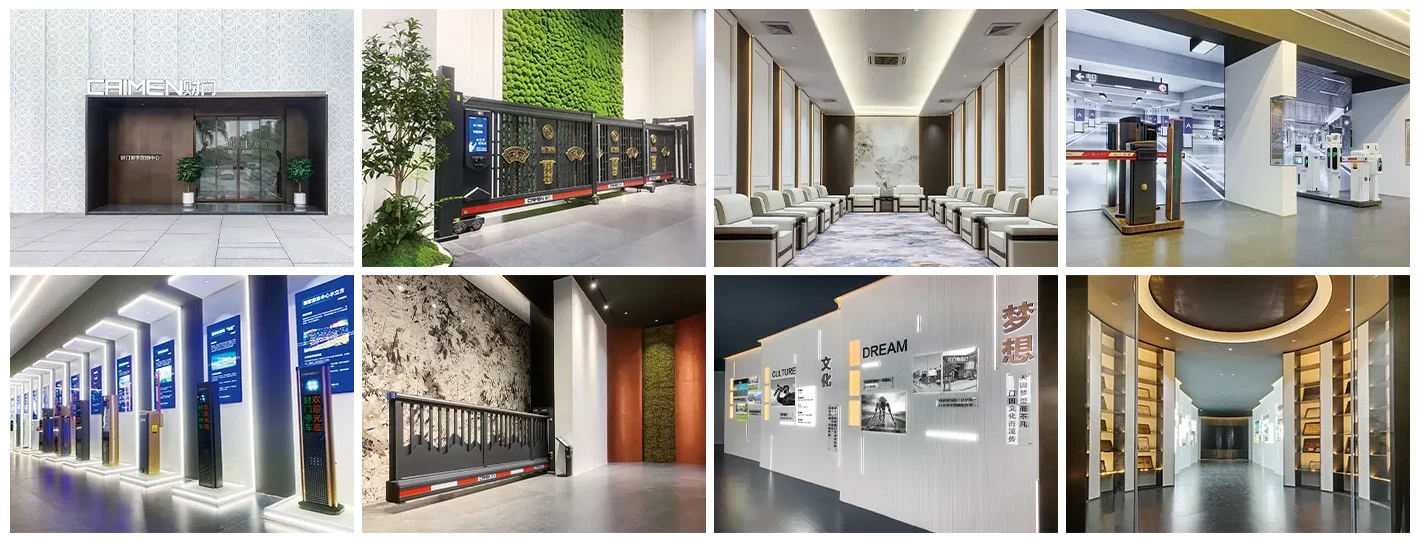
إن about us page provides useful background for evaluating manufacturing capability, R&D resources, and company experience. Buyers can also review دراسات حالة المشاريع to see how entrance control solutions are applied in real sites.
How Do Modern Automatic Gates Improve Factory Security Performance?
They Reduce Uncontrolled Entry
A modern automatic gate creates a controlled access point. When linked with license plate recognition, remote authorization, or identity systems, it helps reduce unauthorized vehicle entry and improves traceability.
This matters for factories with valuable inventory, restricted production zones, hazardous materials, or strict visitor control requirements.
They Improve Guardhouse Efficiency
Manual gate operation creates delays and human error. Automatic operation allows guards to focus on verification, exception handling, and site monitoring. In busy factories, this can improve both security and traffic flow.
The result is not only a stronger entrance but a more efficient entrance management process.
They Lower Long-Term Maintenance Risk
A well-selected gate reduces maintenance caused by poor alignment, corrosion, sensor failure, or motor overload. Buyers should evaluate the full lifecycle cost instead of only the purchase price.
The right gate should fit the opening width, traffic frequency, climate, and control method from the beginning.
التعليمات
Q1. What automatic gate features are most important for factory security?
The most important automatic gate features are a strong frame, stable motor system, smart access control, safety sensors, weather-resistant coating, emergency manual operation, and customization for the actual site layout.
Q2. When should a factory choose a telescopic sliding gate?
A factory should choose a telescopic sliding gate when the entrance is wide but the side storage space is limited. It is also useful when the buyer wants a cleaner layout and flexible section-based customization.
Q3. What should be checked before installing an automatic factory gate?
Buyers should check opening width, side clearance, ground condition, foundation requirements, power supply, access control method, traffic volume, vehicle size, and safety sensor coverage before installation.
استنتاج
Modern factory security depends on more than a strong gate panel. Buyers need a complete entrance system that combines mechanical strength, smart control, safety protection, weather resistance, and site-specific customization.
For wide factory entrances with limited side space, telescopic sliding gates are worth serious consideration. For more complex projects, reviewing product options, checking real project references, and discussing site conditions with the supplier can help avoid costly selection mistakes.
To compare suitable gate structures or discuss a factory entrance layout, buyers can review كايمن’s product information and then use the صفحة الاتصال to request project-specific guidance.